Why Choosing the Right Decking Sheet is Crucial for Your Project's Success in Uttar Pradesh
You know that sinking feeling when the sheets show up late, the slab pour is already booked, and the crew is standing around with nothing to do? It happens a lot. And it usually starts with one wrong material choice.
Quick stat: In a 2025 study of 72 Indian infrastructure professionals, material-related problems ranked as the number one cause of project delays, ahead of site challenges and contractor issues.
A 2024 review points the same way. It named poor material-supply management as the biggest reason Indian projects run late. Late sheets hold up reinforcement, concrete and every trade after that. Then the budget starts to slip too.
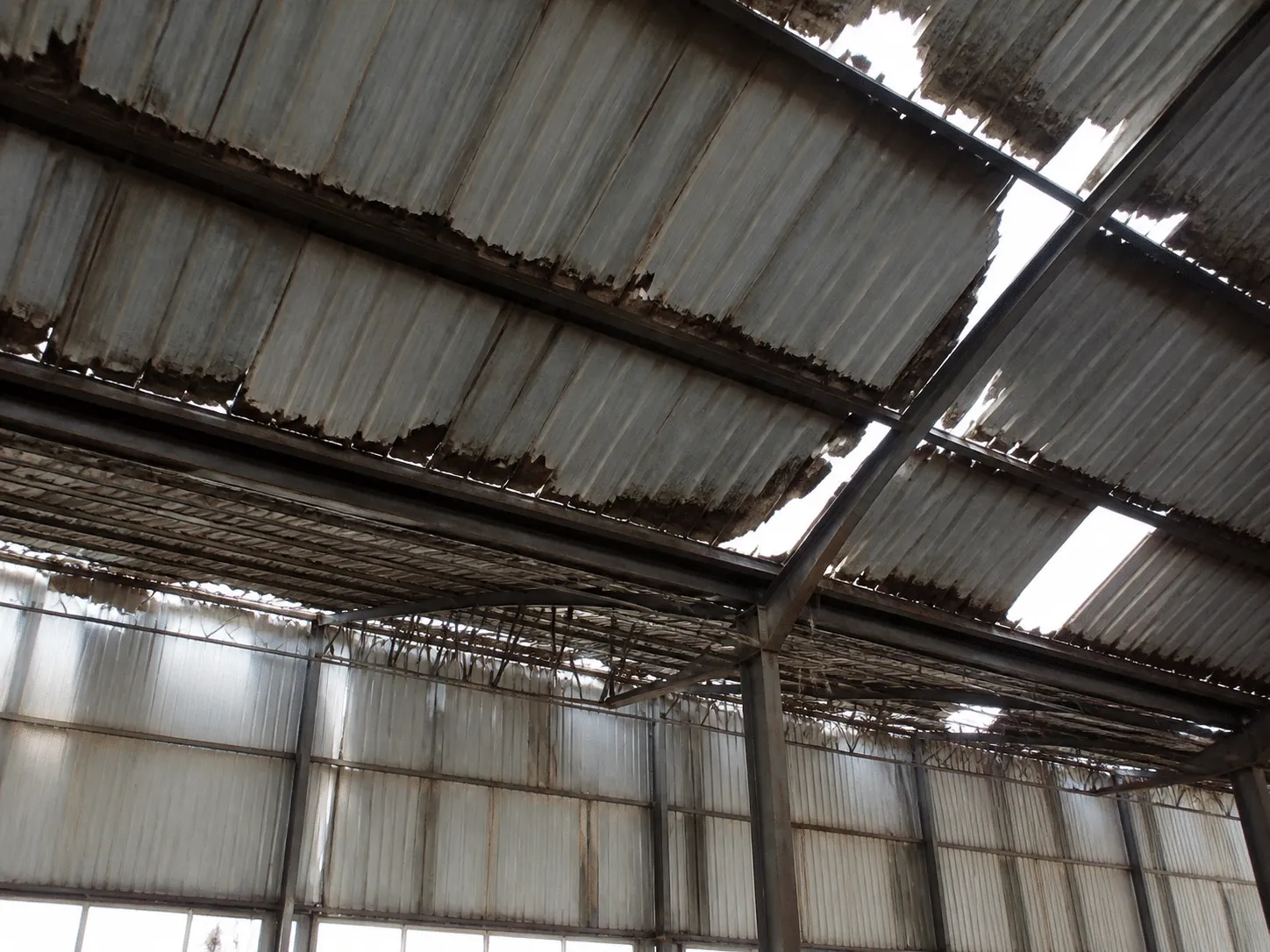
So what does a decking sheet actually do? More than most people think. It holds wet concrete as permanent formwork, and in many designs it works with the slab as part of the floor. Thickness, profile and coating all affect how deep your slab needs to be, how long the floor lasts, and how safe the building feels in 20 years. Pick a thin or poorly coated sheet and you could face sagging, rust and repair bills. Not fun.
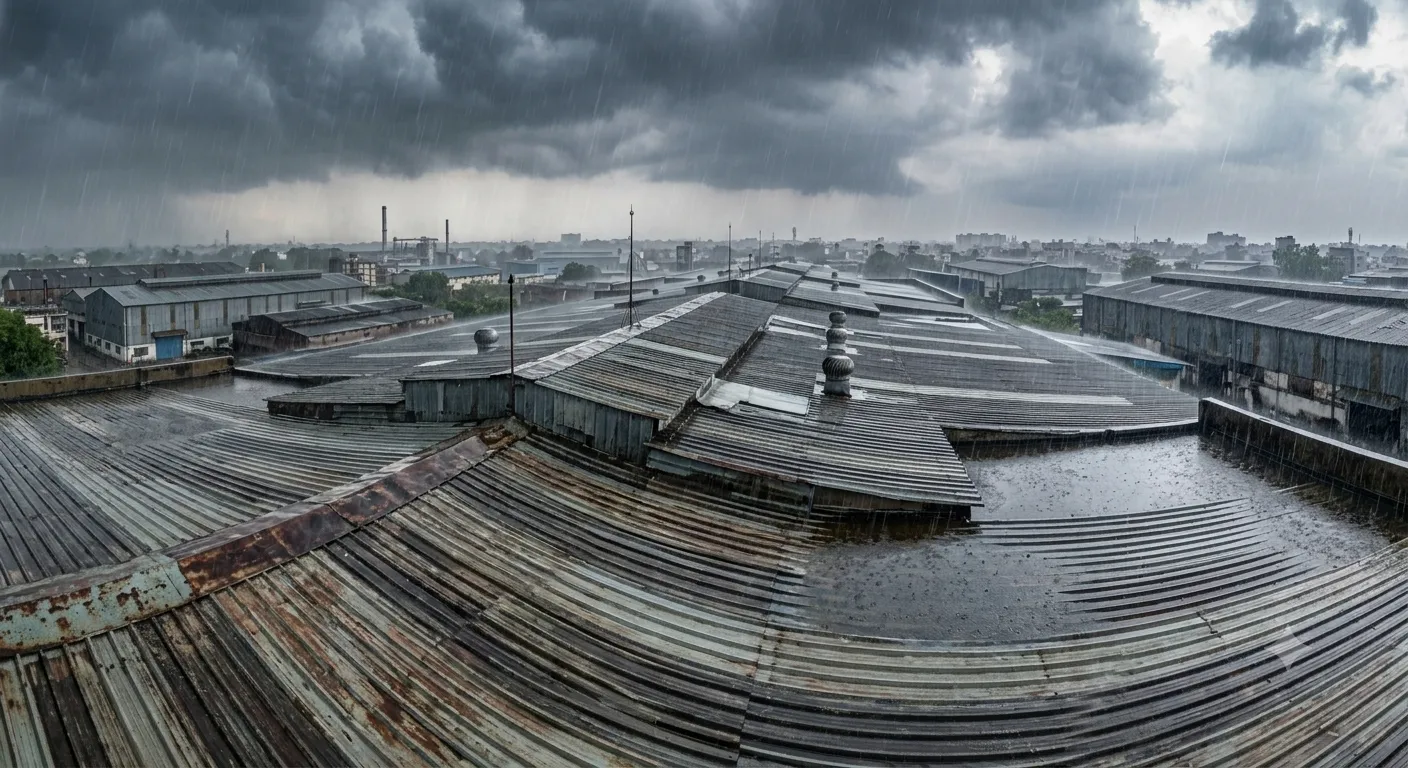
Uttar Pradesh adds its own twists. Northern districts sit in Seismic Zone IV, and the monsoon can hit hard. Northwest India got 27% more rain than normal in 2025. Wet storage and corrosion are real problems here.
This guide comes from our experience as a decking sheet manufacturer in Kanpur at RSG Profile Sheets. We'll walk through the 4 main types, so you can match the right sheet to your site.
1. Galvanized Decking Sheets: The Reliable & Cost-Effective Workhorse
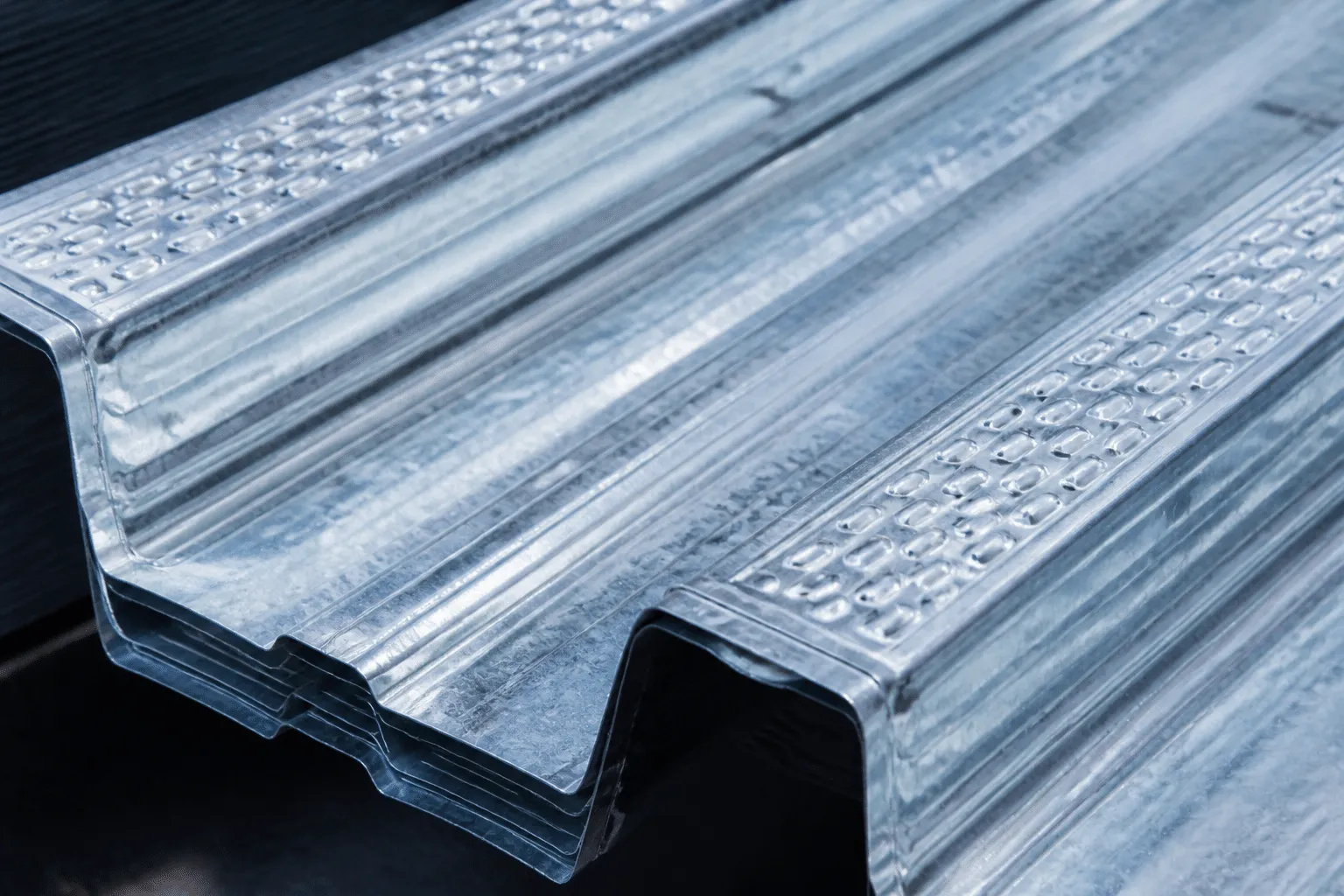
If decking sheets had a job title, galvanized would be "the one everybody calls first." It's not fancy. It just works, and on most Uttar Pradesh jobs it's where we'd start.
What Galvanizing Actually Does
Galvanizing means coating steel with zinc. The zinc acts like a shield. Water and air hit the zinc first, not the steel underneath. Even if a cut edge gets scratched, the zinc nearby keeps protecting it for a while.
For decking, the steel is usually 0.8 to 1.2 mm thick, with profile heights around 50 to 75 mm, based on a Kanpur supplier listing. Look for sheets made to IS 277, the Indian standard for galvanized steel sheets. Ask for the mill certificate too. A "BIS approved" sticker alone isn't proof.
Coating matters as much as thickness. Here's a rough guide, using figures from an India-focused galvanizing source:
Exposure | Zinc coating | Rough zinc mass | Indicative life |
|---|---|---|---|
Low-pollution inland | 65 to 85 microns | about 465 to 610 g/m² | 40 to 50+ years |
Moderate to high pollution | 65 to 85 microns | about 465 to 610 g/m² | 20 to 30 years |
Aggressive or wet exposure | 85+ microns | 610+ g/m² | Specify the heavier coating |
Those are hot-dip numbers (1 micron of zinc is roughly 7 g/m²). Roll-formed deck sheets often carry lighter coatings, so ask your supplier for the exact GSM in writing. Lifespans are guides, not promises.
Why It's the Workhorse
Three things make galvanized deck popular.
First, strength for the weight. Thin steel carries wet concrete without needing heavy supports. Second, price. Current listings show galvanized deck sheets at ₹51 to ₹52 per kg, though prices swing with thickness and order size. For budgeting in 2026, ₹55,000 to ₹80,000 per tonne is a fair starting range.
Third, less upkeep. Keep drainage clear, touch up cut edges with zinc-rich paint, and check the deck once a year. That's about it.
Not the right pick for everything, of course. Chemical plants and coastal sites might need something tougher.
Where It Fits Best
Galvanized deck suits warehouse mezzanines, commercial floors and standard roofing bases. A Greater Noida manufacturer lists it for pre-engineered buildings, factories and warehouses, and that matches what we see at RSG Profile Sheets.
On span, a rough planning figure is 2.0 to 3.5 m without propping. Treat that as a screening number only. Your structural engineer should check the manufacturer's load tables for wet concrete and construction loads before anything gets ordered.
Galvanized is the baseline. Next up is what happens when the deck stops being just formwork and starts working with the slab.
2. Composite Decking Sheets: For Stronger, Lighter, and Faster Slabs
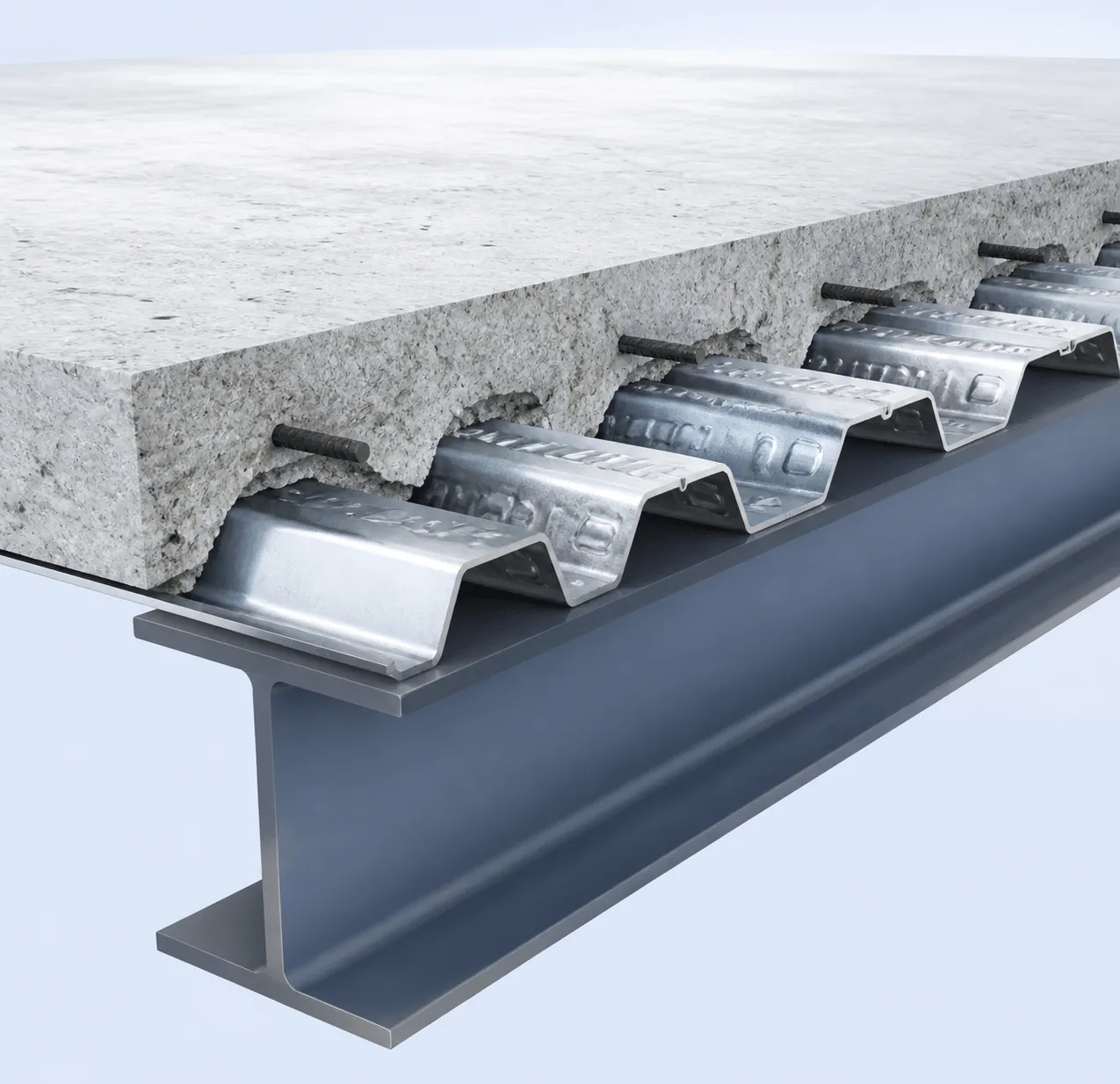
Galvanized deck is the baseline. Composite deck is where the sheet stops being a bystander and starts doing real structural work.
How Composite Decks Actually Work
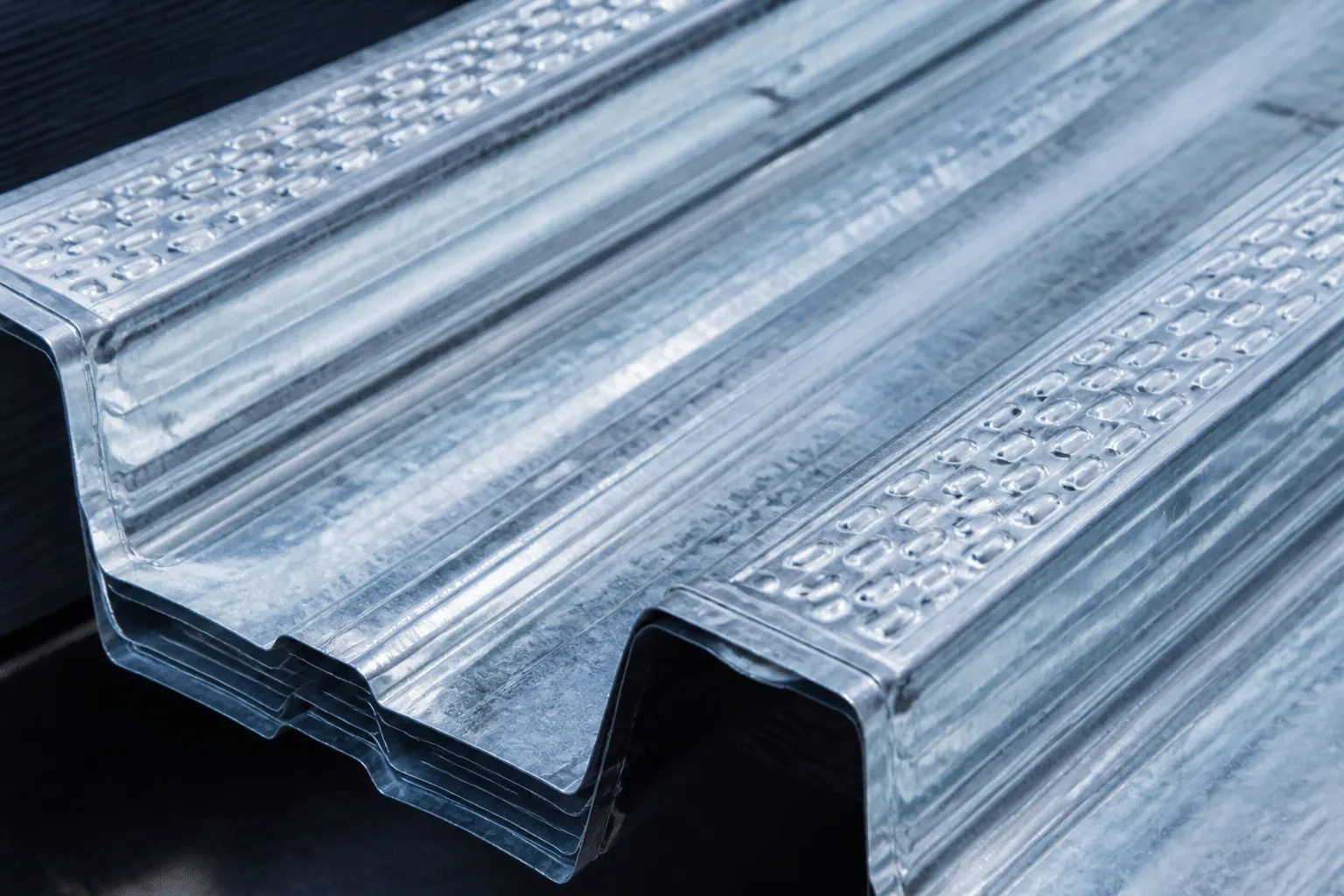
Look closely at a composite deck sheet and you'll spot small bumps, dimples or ribs pressed into the steel. Those are embossments. They're the whole trick.
When wet concrete flows over the sheet, it fills those little shapes. Once it cures, the concrete and the steel are locked together. They can't slide against each other. So the two materials act like one slab, with the steel taking the pulling forces (like rebar would) and the concrete taking the squeezing forces. Newmill's technical page explains that the embossments mechanically interlock with the concrete after curing.
Here's how the pieces fit together:
Part | What it does |
|---|---|
Profiled steel deck | Holds wet concrete, then works as the bottom reinforcement |
Embossments (dimples or ribs) | Grip the concrete and carry shear between the two |
Shear studs | Weld through the deck to the steel beam, tying slab and beam together |
Mesh or top bars | Control cracks and cover support zones |
Concrete topping | Gives the finished floor its strength, fire rating and flat surface |
Want to see it move? This 3D animation of composite steel floor deck construction shows the sheet, the pour and the finished slab in about a minute. Worth watching before your next site meeting.
Why Builders Like It
I'll be honest, the biggest win isn't the steel. It's what you stop doing on site.
The sheet is permanent formwork. No timber shuttering to build, no stripping, no hauling props around. Less labor, fewer days. Some 1.5 inch composite profiles are even advertised for spans above 11 ft without extra shoring, according to Newmill's steel deck brochure.
But how much will you save? Nobody can give you one honest percentage. I looked, and I couldn't find a solid independent study with a universal number. Savings swing with span, floor area, labor rates, crane access and fire rating. So run your own sum: (traditional cost or time minus composite cost or time) divided by traditional, times 100. Count labor, staging, rebar fixing, concrete, crane time and propping, not just the sheet price.
On price, composite floors usually cost more per square meter than bare galvanized sheet, since you're paying for the profile, studs and concrete together. A rough planning index is 115 to 150 against galvanized at 100. For unpropped spans, 2.5 to 4.5 m is a typical screening range, with about 3.5 m as a planning figure. Again, that's only a starting point. Your engineer needs the manufacturer's load tables.
Other perks:
Less concrete volume and often less loose rebar, since the deck acts as bottom steel
Longer spans between beams, which can mean fewer columns
A lighter floor, so lighter frames and foundations
A safe working platform for the next trades
Where It Fits Best (And What to Check)
Composite deck shines on multi-story buildings, car parks, hospitals, malls and infrastructure jobs where speed matters. It's usually paired with steel beams. The shear studs weld through the deck into the beam, so the slab and beam work together as a composite beam. That lets the beam be shallower or lighter for the same load.
On a site in Kanpur or Lucknow, think about the monsoon too. Keep sheets raised and ventilated, and don't let water sit between nested bundles.
Before you order, ask for these specs:
Profile depth, rib spacing and effective cover width (60 mm and 80 mm profiles are common)
Steel grade, thickness and zinc coating mass in writing
Propped and unpropped span tables for wet concrete
Longitudinal shear values and test basis for the embossments
Stud diameter, length, spacing and welding method (19 mm studs are common)
Slab depth needed for your fire rating
At RSG Profile Sheets, we're happy to talk through profiles and coatings with your engineer before you commit. Next, we'll look up, at what sits on top of the building.
3. Roof Decking Sheets: The Structural Foundation for High-Performance Roofing
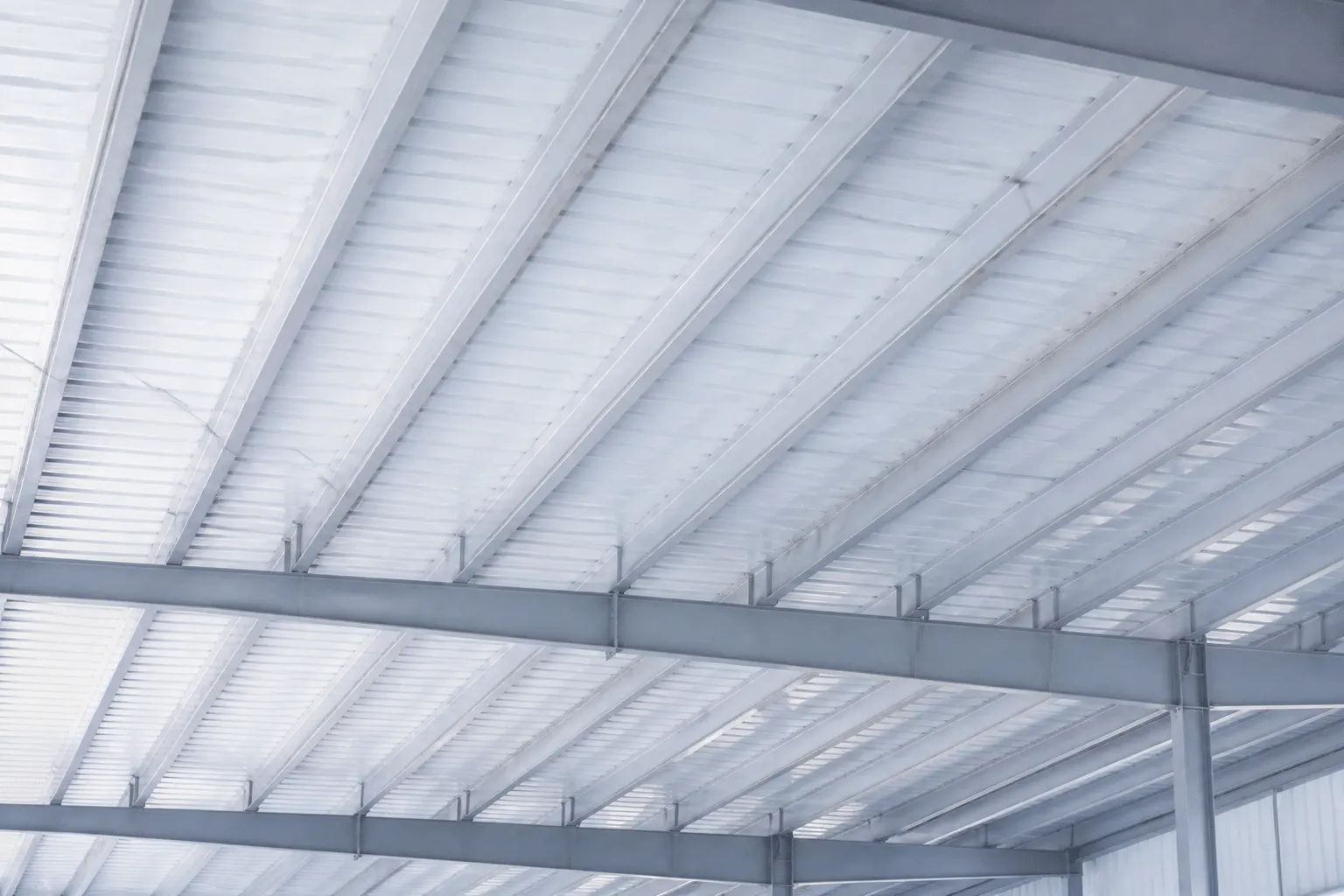
Here's a mix-up I see all the time. Someone asks for "roofing sheet" and gets a thin colored panel. Then they find out the roof needed a proper structural base underneath.
They're not the same thing. Not even close.
Roof Deck vs. Regular Roofing Sheet
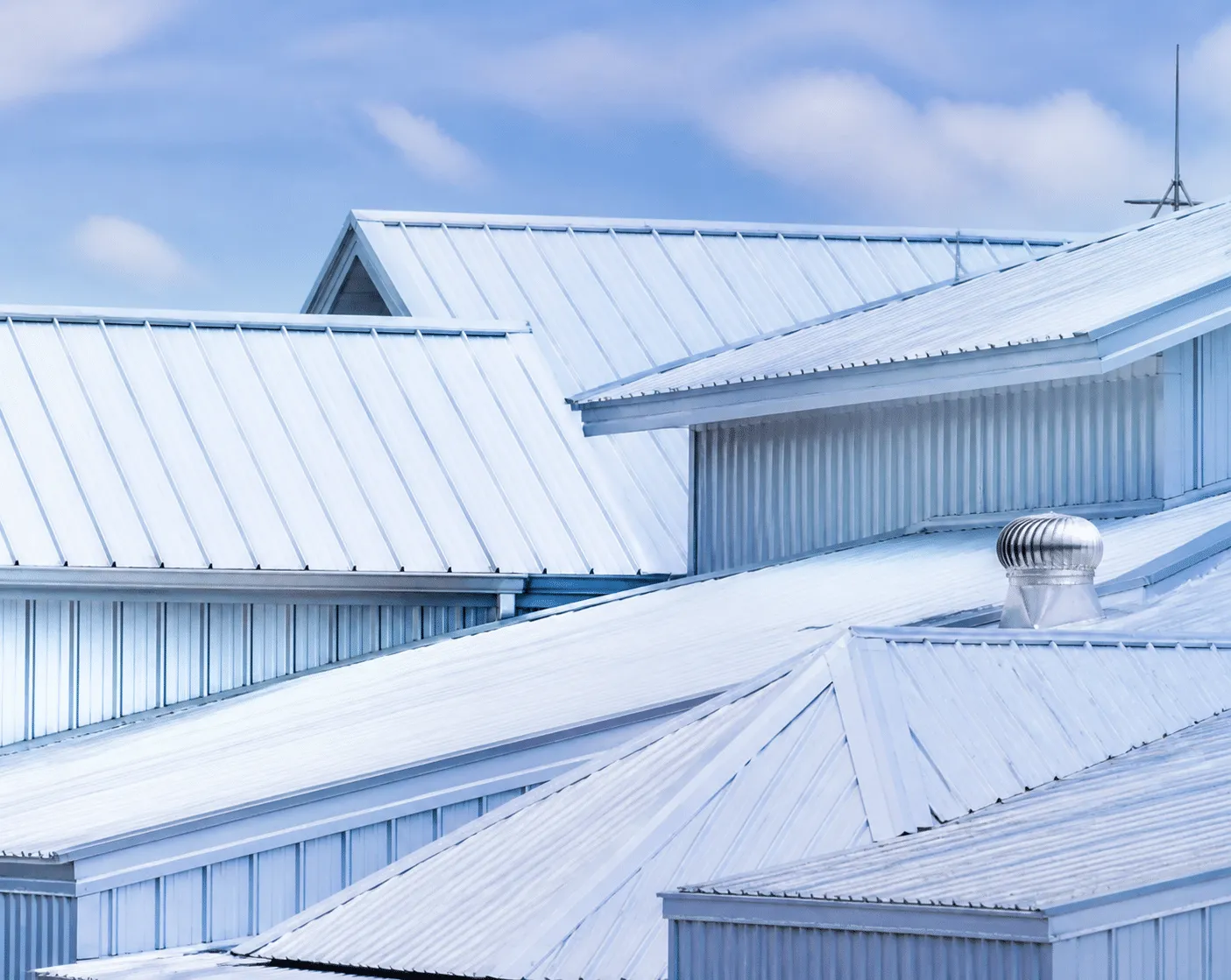
A regular roofing sheet is usually the top skin. It's what you see from the street. A roof decking sheet sits lower down, and its job is to carry the layers above it. Think of it as the floor of your roof.
Most roof decks use a trapezoidal deck profile, with deep ribs that add stiffness without adding much weight. Steel thickness, rib depth and coating all matter when you're reading roof decking sheet specifications, so ask for them in writing.
Here's how a full roof build-up stacks up, from the bottom:
Layer | What it does |
|---|---|
Roof decking sheet | Carries every layer above it and spans between purlins or rafters |
Vapor barrier | Stops moisture from the building rising into the insulation |
Insulation | Keeps heat out in summer and cuts cooling costs |
Waterproofing membrane | Keeps rain from getting through laps, joints and fasteners |
Skip the vapor barrier and the insulation can get damp. Damp insulation stops working. Simple as that.
Why the Base Layer Matters
A roof isn't just sitting there. It takes wind, rain and workers walking around for years.
For ordinary roofs, NBC 2016 structural provisions commonly apply 1.5 kN/m² for an accessible flat roof, 0.75 kN/m² for a non-accessible sloping roof, and a 1.8 kN concentrated load where it applies. Factories add more. Think solar panels, ducts, sprinklers and regular maintenance crews. Your engineer works those out, along with wind uplift, under IS 875.
A stiff, well-coated deck gives the insulation and membrane a flat, stable surface. That means fewer ripples, fewer ponding spots and fewer leaks. In Uttar Pradesh, with heavy monsoon rain, that's a big deal.
Insulation choices are wide. PUF sandwich panels are common, and one Indian roofing supplier lists PUF density at 40 kg/m³ with several steel skin options. Mineral wool, XPS boards and foil-faced foams also show up a lot. Pick based on fire, heat and budget. (I'd lean toward mineral wool wherever fire rules are strict.)
Where Roof Decking Earns Its Keep
Large-span industrial buildings are the obvious fit: factories, warehouses and logistics sheds where columns need to be few and far between. Commercial complexes use it too, and so do public projects like airports and metro stations, where a failed roof isn't an option.
Some quick tips for the site:
Detail laps, flashings and penetrations early. Geometric Steels promotes corrosion-resistant flashing aimed at cutting leak-prone joints, though that's a manufacturer claim.
Keep falls and drainage clear so water never pools.
Use compatible fasteners and washers to avoid mixed-metal corrosion.
Check the deck coating against your site's humidity and pollution.
At RSG Profile Sheets, we can talk through trapezoidal profiles, thickness and coating with your engineer before you order. Now, what if the standard profile just won't do?
4. Custom & Trapezoidal Profile Decking Sheets: Achieving Architectural & Structural Goals
Ever had an architect hand you a drawing and say, "We need this exact look"? And then the standard catalog sheet just doesn't match. I've seen that conversation go sideways fast.
That's where custom profiles come in.
What Custom Profiles Really Are
Most manufacturers keep a few standard profiles in stock. A custom profile is different. It's a sheet rolled to your own shape, depth, rib spacing or cover width, so it fits your engineering or design brief.
The trapezoidal deck profile is the most common starting point. It has flat tops and sloped sides, a bit like a row of low mountains. Custom work can change the rib height, the angle of the sides, the side-lap shape, or add stiffeners in the troughs. Some profiles are even dovetailed (re-entrant), where the rib narrows at the top to grip concrete.
Here's a quick look at the shapes you'll hear about:
Profile type | What it looks like | Where it tends to help |
|---|---|---|
Trapezoidal | Flat crests, sloped sides | Roofs, floors, general formwork |
Deep trapezoidal | Taller ribs, wider spacing | Longer spans, fewer supports |
Dovetailed (re-entrant) | Ribs that narrow at the top | Composite slabs that grip concrete |
Custom hybrid | Your own rib mix and side laps | Facades, odd loads, brand looks |
Why It Matters
Let's be honest. Limited choice is a real headache for builders. Some suppliers only offer what's on the shelf, and you end up bending the design to fit the sheet. Backwards.
A custom profile can fix a few things at once:
Better spans. A deeper or stiffer rib can carry the same load over a longer gap, so you may need fewer props or beams.
A specific look. Rib spacing and finish can match a brand color or a facade pattern.
Smarter drainage. Wider valleys or added falls help water run off instead of sitting in pockets. That counts in a Kanpur monsoon.
There's a catch (there always is). Custom work can cost more. The manufacturer may need new roll tooling, drawings and a trial run. Marketplace listings put standard deck at roughly ₹60 to ₹90 per kg, but those are indications, not firm quotes. I couldn't find a trustworthy public number for the custom premium, so I won't invent one. Ask for tooling as its own line item, and find out if it's reusable on repeat orders.
When You Actually Need One
Not every job does. A plain warehouse floor is usually fine with a standard sheet. But a custom profile starts to make sense when:
The building has curves, odd angles or a complex roof shape
Loads are unusual, like heavy equipment, solar arrays or long open spans
A commercial facade or roof needs a particular brand look
Drainage has to work around tricky falls or penetrations
Indian suppliers already do some of this. For example, Metal Scope India makes standing-seam roofing in long, on-site profiled lengths, which helps low-slope roofs with fewer joints.
Working With Your Manufacturer on Custom Solutions
This part saves the most time. Come prepared, and the process runs smoothly.
Send the manufacturer these basics:
A dimensioned drawing, CAD file or clear sketch of the profile
Where it's going: roof, floor, mezzanine or formwork
Steel grade, thickness and zinc coating (decking is often listed around 0.70 to 1.20 mm)
Span, loads, deflection limits and support widths
Sheet lengths, quantity and delivery dates
Site conditions like slope, moisture and chemical exposure
Then ask for a shop drawing to approve before rolling starts. For a brand-new shape, a short trial run is smart. And ask for two written schedules, one for standard sheets and one for custom, with separate dates for approval, tooling, trial and dispatch.
At RSG Profile Sheets, we're happy to look over your drawings with your engineer and tell you what's realistic. Now that we've covered all four types, let's put them side by side.
Quick Comparison: Which Decking Sheet Fits Your Project Needs?
Busy day? Skip the long reads and use this table. It puts all four types side by side so you can shortlist fast, then ask your engineer to confirm.
I've used a simple rating for cost: $ is the baseline, $$ costs a bit more, and $$$ is the priciest and often involves extra tooling or design work.
Sheet Type | Primary Application | Relative Cost | Key Benefit | Ideal Project Type |
|---|---|---|---|---|
Galvanized Decking Sheets | Permanent formwork, mezzanines, standard roof bases | $ (baseline) | Low price and low upkeep | Industrial sheds, warehouses, basic commercial floors |
Composite Decking Sheets | Structural floor slabs working with concrete and steel beams | $$ | Longer spans, less shuttering, faster floors | Multi-story commercial, malls, hospitals, car parks |
Roof Decking Sheets | Structural base under insulation and waterproofing | $$ | Stiff, stable base for the roof layers | Factories, logistics sheds, airports, public buildings |
Custom & Trapezoidal Profile Sheets | Special loads, odd shapes, branded facades or roofs | $$ to $$$ | Made to fit your drawing, not the other way round | Architect-led commercial, complex industrial, special loads |
How to Read It
A few quick tips, so the table doesn't mislead you.
Cost is relative. It shows how the types compare, not a quote. Prices move with thickness, coating and order size.
Speed matters too. Composite floors cost more per square meter, but you skip a lot of timber work and propping. Count the whole job, not just the sheet.
Custom isn't always needed. If a standard sheet fits, take it. It's usually cheaper and ships faster.
A Fast Way to Pick
Still torn? Try this.
Simple floor or formwork on a tight budget? Start with galvanized.
Multi-story building where time is money? Look hard at composite.
Big roof with insulation going on top? Go for a proper roof deck.
Drawing that standard sheets can't match? Ask about a custom profile.
Of course, the sheet is only half the story. The manufacturer behind it matters just as much, and that's what we'll look at next.
5 Critical Factors When Choosing a Decking Sheet Manufacturer in Kanpur
Picking the sheet type is half the job. Picking who makes it? That's the other half, and plenty of people rush it.
I'll be upfront: a low price per kg can look great on a quote. Then the sheets arrive thin, or two weeks late, and nobody picks up the phone. Here's what to check before you sign anything.
Quality Checks You Can Actually Verify
Start with paperwork. A good manufacturer should show you current, independently checked certificates, not just a logo on a brochure.
ISO 9001:2015 covers quality systems like inspections, corrective actions and traceability.
ISO 14001 and ISO 45001 cover environmental and worker safety management. Nice to have, and they tell you how organized the factory is. Jindal (India) Limited, for example, announced dual ISO certifications in 2026.
IS code compliance matters most. Ask which Indian Standard governs the sheet grade and coating. A general "BIS approved" claim isn't enough.
Also check the certificate's scope, factory location, issuing body, number and expiry date. A certificate for a different plant or a trading office doesn't cover decking sheets rolled in Kanpur.
Then ask about in-house testing. Can they show mill test certificates with steel grade, yield strength, coating mass, thickness and batch number? If a supplier can't trace a batch, that's a red flag. Walk away.
Delivery and Supply Reliability
Remember the late-sheet story from the start of this guide? This is where it gets solved. A local manufacturer with a strong delivery network across Uttar Pradesh can cut transport time and make schedules easier to trust.
But certificates don't prove stock. I couldn't find public data on how supply disruptions hit Kanpur projects specifically, so I won't make up a number. Ask the supplier instead:
How fast did they deliver to Uttar Pradesh sites on recent jobs?
Do they hold coil and sheet stock near Kanpur?
What happens if a batch is rejected or a truck is delayed?
Can they keep buffer stock for critical deck areas during monsoon months?
Get the answers in writing, with a dispatch schedule.
Technical Support, Not Just a Sales Call
A supplier sells sheets. A partner helps you use them properly. Big difference.
Good support usually means:
A pre-installation review of span, support spacing, openings and edge details
Help with load-span tables, and coordination with your structural engineer
Site or video guidance on cutting, lapping, fixing and storage
A named contact who answers site queries
A clear process for replacing damaged or defective sheets
No guesswork on a Friday evening with a pour booked for Monday.
Your Supplier Checklist
Supplier checklist: tick these before you order
* ISO 9001:2015 certificate, with scope, plant location and expiry date checked
* Named Indian Standard for the sheet, plus the exact BIS licence
* Mill test certificate for every batch (grade, thickness, zinc coating, batch number)
* Written profile, thickness, coating, cover width and length details
* Load and span tables approved by your engineer
* Written delivery schedule and buffer stock plan
* Named technical contact and replacement timeline
* Total delivered cost compared, not just the price per kg
At RSG Profile Sheets, we're happy to go through this list with your team and your engineer. Ready to wrap it all up? Let's do that next.
Build with Confidence: Partner with Kanpur's Decking Sheet Experts
So here's the big picture. A decking sheet isn't just steel you buy and forget. It's a choice that touches your budget, your schedule and how the building holds up years from now.
Galvanized, composite, roof or custom, each type has a job. Pick the right one and your pour day runs smooth. Pick the wrong one and you're chasing repairs and late trucks. We've all seen how that story goes.
The maker behind the sheet matters just as much. A local team that knows Uttar Pradesh weather, answers the phone and ships on time can save you weeks. (And a few headaches, honestly.) Look for clear mill certificates, written specs and an engineer you can talk to before you order.
Ready to Talk About Your Project?
Ready to ensure structural integrity and efficiency for your next project? Contact RSG Profile Sheets, your trusted decking sheet manufacturer in Kanpur, for a technical consultation and quote.
To make the first call quick, have these handy:
Project location and floor or roof area
Span and slab thickness
The sheet profile you're considering
Your delivery deadline
Then reach out to RSG Profile Sheets and share your drawings. Our team will go through them with your engineer and tell you what's realistic. No pressure, just straight answers.